Qualified Leads · October 12, 2026 · GrowthPros
Lead Generation Techniques for Sleep Clinics and Roofing Companies
Maximize conversions with exclusive leads and AI-powered follow-up. Get qualified leads for sleep clinics and roofing companies with GrowthPros' expert ...
Key Facts
- 78% of customers hire the first business to respond according to speed-to-lead research.
- 45% conversion rate on 270 roofing leads via targeted campaigns documented by Dreamworks Restoration.
- 100x higher contact rate for 5-minute responses vs. 30-minute delays per home-services research.
- 80% of sleep apnea cases remain undiagnosed industry analysis shows.
- Exclusive leads close 15–30% higher than shared ones research reveals.
- 8–15% reactivation rate for dormant, opted-in lists via multi-channel AI sequences.
- Sleep medicine market to reach $11B by 2028 with 70M affected Americans industry projections indicate.
The Race Nobody Wins Slowly: Why Both Sectors Leak Revenue at the First Response
A homeowner with a leaking roof at 9 p.m. and a patient who finally googled "why can't I sleep" have the same problem: they want an answer now. In both cases, the clinic or contractor that responds first usually wins, and everyone else pays for the ad spend that generated the lead.
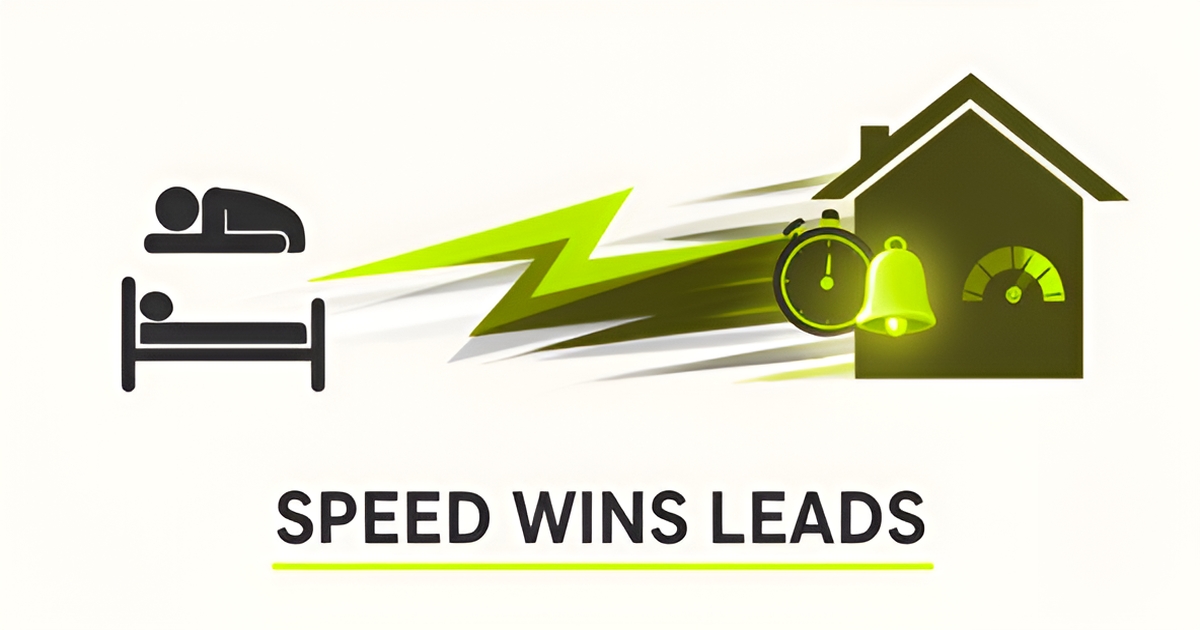
The numbers make this brutally clear. According to home-services research, 78% of customers hire the first business that responds to their inquiry. The same research found that responding within five minutes produces a contact rate roughly 100 times higher than waiting thirty minutes. That half-hour gap is where most revenue quietly leaks out of both sectors.
Consider what actually happens after a lead arrives. A roofing company's office phone rings during a job-site inspection. A sleep clinic's intake coordinator is with a patient. The inquiry sits unanswered, and by the time someone calls back, the homeowner has signed with a competitor or the patient has booked elsewhere. The lead wasn't bad. The response was.
The stakes are rising on both sides. The sleep medicine market is projected to reach $11 billion by 2028, with 70 million Americans affected by sleep disorders, and industry analysis estimates 80% of sleep apnea cases remain undiagnosed. Meanwhile, sleep doctors are moving toward private practice and direct patient payment as insurance friction and administrative burdens mount, meaning every inquiry a clinic generates now carries more of its own revenue weight.
Roofing shows what's possible when speed and targeting align. One contractor, Dreamworks Restoration, achieved a 45% conversion rate on 270 leads through targeted online campaigns and fast response. That result isn't luck, it's the compound effect of qualified leads meeting near-immediate contact.
The pattern across both industries points to the same three failure points:
- Leads arrive during hours when no one on the team can answer.
- Follow-up depends on whoever remembers to call back, not on a process.
- Response times stretch past the window where the lead is still shopping.
This is why speed-to-lead has become the single biggest conversion lever in both health and home services, and why lead quality and response speed have to be solved together. A qualified, time-stamped lead that sits in a shared inbox for an hour is worth a fraction of the same lead contacted in minutes. It's also why providers like GrowthPros build AI-powered follow-up across voice, SMS, and email into every lead delivered, rather than treating response speed as the client's afterthought.
The race nobody wins slowly has a simple rule: the lead goes to whoever answers first. Everything else, ad budgets, referral networks, brand reputation, only determines whether you're in the race at all.
Two Markets, One Playbook: Capturing Undiagnosed Patients and Storm-Driven Homeowners
At first glance, a sleep clinic and a roofing contractor have nothing in common, one diagnoses disorders you can't see, the other repairs damage you can. But scratch the surface and both businesses live or die on the same question: how do you find the person who needs you before they find someone else?
Sleep clinics sit on top of an enormous, largely invisible market. According to industry research, 70 million Americans are affected by sleep disorders, and roughly 80% of sleep apnea cases go undiagnosed. These aren't people searching for "sleep clinics near me" in large numbers. Many don't yet know they have a problem, which is why symptom-based content marketing and targeted Google Ads work so well in this space: you meet patients at the symptom ("why do I wake up gasping?"), not the diagnosis.
Roofing demand looks completely different. It's event-driven, a hailstorm or wind event creates a sudden, concentrated pocket of homeowners who all need the same thing at the same time. The winning play is precision: targeted AdWords campaigns aimed at storm-affected neighborhoods, not broad brand awareness. The results can be striking. A documented case study of Dreamworks Restoration Contractors showed a 45% conversion rate on 270 roofing leads, a number most industries would consider impossible.
The lesson from both sectors is that who you target matters far more than how many leads you generate. A thousand generic leads convert worse than a hundred leads matched to a defined buyer with real, present intent. That's the principle behind qualified, niche-specific lead sourcing, and it's why GrowthPros sells leads by niche rather than by volume, with each contact qualified and consent-recorded before delivery.
The second half of the equation is speed. Speed-to-lead research shows that 78% of customers hire the first business to respond, and contacting a lead within five minutes makes contact roughly 100x more likely than waiting thirty. A sleep clinic's inbound patient and a storm-driven homeowner behave identically here: whoever answers first wins.
Both markets are also being reshaped by structural change. The American Academy of Sleep Medicine notes that insurance friction and administrative burden are pushing sleep doctors toward private practice and direct patient payment, meaning clinics now compete for patients like any consumer business. Roofing contractors face their own squeeze from shared-lead marketplaces, where the same lead goes to five competitors.
The playbook that works in both markets:
- Target by niche and trigger event, symptoms for clinics, storms for roofers, not by generic demographics.
- Respond inside minutes, not hours; the first responder captures roughly three-quarters of buyers.
- Insist on qualified, exclusive or capped-shared leads rather than dumped shared lists.
- Track conversion per lead source, not just cost per lead.
Niche-specific targeting with fast follow-up beats generic lead volume every time, whether your patient can't sleep or your customer can't stop the leak.
Exclusive vs. Shared: The Lead Quality Math That Decides Your Cost Per Job
The cheapest lead on the market is almost never the cheapest lead to close. That's the trap that catches both roofing contractors burned by marketplace lead dumps and sleep clinics watching their acquisition costs climb, and the math behind exclusive versus shared leads explains why.
On shared marketplaces in the Angi/HomeAdvisor mold, your lead arrives alongside four other buyers racing to the same phone number. 78% of customers hire the first business that responds, according to speed-to-lead research, so a five-buyer lead is really a lottery ticket where the prize goes to whoever dials fastest. Contact rates collapse too: responding within five minutes makes contact roughly 100x more likely than waiting thirty.
Exclusive leads flip that equation. Yes, they cost 2–4x more per lead than shared ones, but they close 15–30% higher because nobody is competing for the prospect's attention. The same logic applies to capped-shared models that limit a lead to two buyers maximum, a middle ground that keeps per-lead cost down while preserving most of the conversion advantage. GrowthPros, for example, delivers leads by niche on exactly that basis: exclusive or capped at two, each qualified and time-stamped, never dropped into a shared inbox.
The real-world results back this up. Dreamworks Restoration Contractors achieved a 45% conversion rate on 270 roofing leads through targeted campaigns with fast follow-up, the kind of close rate that makes a higher per-lead price irrelevant. Run the cost-per-job math and exclusive leads win even at 4x the sticker price:
- Shared lead at $30 closing at 5% = $600 per job
- Exclusive lead at $120 closing at 20% = $600 per job
- Exclusive lead at $120 closing at 25% = $480 per job
For sleep clinics, the stakes are even higher as the industry shifts. With sleep doctors turning toward private practice and direct patient payment models to escape insurance friction, every lead represents a patient relationship you now own end-to-end. And with 80% of sleep apnea cases undiagnosed, a qualified, exclusive lead isn't competing with four clinics, it's often the patient's first real conversation about treatment.
The bottom line: compare cost per job, never cost per lead. A marketplace lead that's cheap, shared five ways, and answered an hour late is the most expensive lead you'll ever buy.
The Five-Minute Follow-Up System: AI Speed-to-Lead in Practice
A roofing lead can go cold in half an hour. Research on speed-to-lead in home services shows that contacting a lead within five minutes makes contact roughly 100x more likely than waiting thirty minutes, and 78% of customers hire the first business to respond. For sleep clinics and roofers alike, the follow-up system matters as much as the lead itself.
Building a five-minute response machine comes down to three layers working together: AI voice, SMS, and email. The moment a lead arrives, whether freshly sourced or reactivated, an AI voice call attempts contact, an SMS follows in parallel, and an email backs both up. This runs 24/7, because storm-damage homeowners and exhausted patients don't fill out forms on a convenient schedule. The goal of each touchpoint is simple: qualify intent and book the call or hand off a warm, live contact to your team.
Delivery matters as much as speed. A lead that lands in a shared inbox is a lead that gets seen at 4 p.m. tomorrow. Every lead should arrive in your CRM, via webhook, Zapier, or native integration into platforms like Salesforce, HubSpot, Follow Up Boss, or ServiceTitan, with its consent trail attached: disclosure text, timestamp, IP address, and the named contacting party. That record protects you and speeds up the first conversation.
Compliance is not optional, especially in healthcare-adjacent outreach:
- Scrub every list against the DNC registry before any outbound contact.
- Honor opt-outs immediately and permanently across SMS, voice, and email.
- Reactivate only pre-existing, opted-in relationships, never cold lists.
- Build toward FCC one-to-one consent standards from day one.
The same system revives revenue you've already paid for. Dormant, opted-in patient and customer databases typically see 8–15% of the list re-engage when hit with a multi-channel AI sequence, SMS first, voice follow-up, email backup. For a sleep clinic sitting on years of patient inquiries, or a roofer with a stale estimate list, that's a pipeline hiding in plain sight, and reactivation typically costs 60–80% less than buying new leads.
The payoff is real when speed and quality combine. One roofing contractor, Dreamworks Restoration Contractors, converted 45% of 270 leads through targeted campaigns and rapid response. And with 80% of sleep apnea cases still undiagnosed, the clinic that responds first often wins the patient.
If you want every lead, new or dormant, worked inside five minutes, GrowthPros includes AI voice, SMS, and email follow-up with every lead delivered. Book the free 15-minute qualification call to see if the fit is right.
Your First Conversation: Qualifying the Fit Before You Buy a Single Lead
When it comes to generating leads for sleep clinics and roofing companies, the first conversation is crucial in determining the success of the lead generation process. According to industry research, 78% of customers hire the first business to respond to a lead, making speed-to-lead a critical factor in converting leads into sales.
For sleep clinics, adapting to changing market conditions is essential, as noted in a recent study on the sleep medicine market. This includes shifting towards private practice and direct patient payment models, as well as leveraging online marketing strategies to capture undiagnosed sleep disorder patients. In fact, industry data shows that 70 million Americans are affected by sleep disorders, and 80% of sleep apnea cases are undiagnosed.
To maximize conversions, businesses in the home services sector, such as roofing companies, should prioritize speed-to-lead and respond quickly to leads. A case study found that Dreamworks Restoration Contractors achieved a 45% conversion rate on 270 roofing leads by responding quickly to leads and using targeted online marketing campaigns.
Some key considerations for businesses looking to generate leads include:
- Understanding the importance of speed-to-lead and responding quickly to leads
- Leveraging online marketing strategies to capture undiagnosed sleep disorder patients or generate high-quality leads
- Adapting to changing market conditions, such as shifts towards private practice and direct patient payment models
By prioritizing these factors, businesses can increase their chances of converting leads into sales. Exclusive leads can be particularly effective, as they are more likely to result in sales. In fact, research shows that responding to leads within 5 minutes can result in a 100x higher contact rate compared to responding within 30 minutes.
To get started with generating high-quality leads, businesses can schedule a 15-minute qualification call with a lead generation expert. This call is free, honest about fit, and commits the buyer to nothing. During the call, businesses can discuss their specific needs and goals, and determine the best approach for generating leads in their niche. For home services, such as roofing, this can include discussing the cost-per-lead, which can range from $30 to $150+, and deciding between exclusive, capped-shared, or reactivation leads. By taking this first step, businesses can set themselves up for success in generating high-quality leads and driving sales.
Frequently Asked Questions
How fast do I really need to respond to a lead before I lose it?
Faster than you probably think: 78% of customers hire the first business that responds, and contacting a lead within five minutes makes contact roughly 100x more likely than waiting thirty minutes. If your follow-up depends on whoever remembers to call back, you're likely losing leads that were perfectly good.
Aren't cheaper shared leads the smarter buy for a small budget?
Usually not, the math flips when you compare cost per job, not cost per lead. Exclusive leads cost 2–4x more but close 15–30% higher, so a $120 exclusive lead closing at 25% costs $480 per job versus a $30 shared lead closing at 5% at $600 per job. A documented roofing case study hit a 45% conversion rate using targeted, fast-followed leads, that's what makes the higher sticker price irrelevant.
How do sleep clinics find patients who don't know they have a sleep disorder?
You meet them at the symptom, not the diagnosis, symptom-based content marketing and targeted Google Ads capture people searching things like "why do I wake up gasping." It's a big opportunity: 70 million Americans are affected by sleep disorders and roughly 80% of sleep apnea cases go undiagnosed, so a qualified lead is often the patient's first real conversation about treatment.
Why is everyone talking about sleep doctors moving to private practice, does that change how clinics get patients?
Yes. The American Academy of Sleep Medicine notes that insurance friction and administrative burdens are pushing sleep doctors toward private practice and direct patient payment. That means every inquiry now carries more of its own revenue weight, and clinics have to compete for patients like any consumer business, speed and lead quality matter as much as clinical reputation.
Can I revive the old leads sitting in my CRM instead of buying new ones?
Often, yes, dormant, opted-in lists typically see 8–15% re-engage when worked with a multi-channel AI sequence (SMS first, voice follow-up, email backup), and reactivation costs 60–80% less than buying new leads. The key is only reactivating pre-existing, opted-in relationships, never cold lists, and DNC-scrubbing before any outbound contact.
What should I ask about before buying leads from any provider?
Ask whether leads are exclusive or shared (and if shared, capped at how many buyers), whether each lead is qualified and time-stamped with a consent trail, and how fast follow-up happens. Since roughly three-quarters of buyers choose whoever responds first, a qualified lead sitting in a shared inbox for an hour is worth a fraction of one contacted in minutes. A short qualification call, like GrowthPros' free 15-minute fit call, should set real pricing without committing you to anything.
The Lead Goes to Whoever Answers First
Sleep clinics and roofing companies turn out to run on the same engine: a qualified lead, contacted fast, by the business that showed up first. The math is unforgiving, 78% of customers hire the first responder, and a five-minute reply makes contact roughly 100x more likely than a thirty-minute one. Meanwhile, cheap shared leads quietly cost more per job than exclusive ones that close 15–30% higher, and the dormant, opted-in list already sitting in your CRM is often the cheapest pipeline you own. So audit your response times this week. Ask where your leads actually land, and how many buyers see each one. If the answers make you wince, that's the leak to fix first. GrowthPros delivers exclusive and capped-shared leads by niche, qualified, time-stamped, and consent-recorded, with AI voice, SMS, and email follow-up inside the five-minute window built in. Book the free 15-minute qualification call: it's honest about fit and commits you to nothing.
This article is general information, not legal or financial advice. Benchmark figures are directional industry data, not guarantees of results.